Your Google Ads bills keep climbing, but your lead quality keeps dropping. You're paying more and getting less. Sound familiar?
If you're running a personal injury law firm in Australia, you've probably noticed the cost per click for your core keywords has jumped 20-40% every single year for the last five years. That's not a small increase. That's a systematic squeeze that's pushing smaller firms out of the market entirely.
The worst part? Most PI firms don't have a choice. Turn off the ads, and your pipeline collapses within weeks. Keep them running, and you're watching your margins disappear while Shine and Slater & Gordon scoop up the high-value cases you can't afford to compete for.
This isn't a problem you can optimise your way out of. The system is designed to favour the firms with the deepest pockets, and if you're trying to play the same game they are, you're going to lose.
But there's a different way to think about this. One that doesn't involve competing with national firms on their terms.
Key Takeaways
Here's what you need to know about personal injury Google Ads costs and what you can actually do about it:
-
Cost per click for "personal injury lawyer Sydney" has hit $224 (yes, per click, not per lead), making it nearly impossible for smaller firms to compete profitably
-
National firms like Shine and Slater & Gordon can afford $800-1500 per lead because of their volume, case values, and funding structures that most boutique firms simply don't have
-
Google's "close variants" feature means even phrase match and exact match will trigger your ads on competitor brand searches unless you actively add them as negative keywords
-
Broad match CAN work but requires 50+ conversions per month to train properly - most Australian PI firms don't have that volume, making it a budget drain
-
Most PI firms are training Google's algorithm wrong by counting every lead as a conversion, teaching it to find volume instead of quality (the "puppy getting a biscuit for the wrong behaviour" problem)
-
Adding qualification questions to your forms (injury date, employment status, etc.) lets you send better conversion signals to Google, training it to find leads that actually become clients
-
The real solution isn't competing harder on Google, it's reaching potential clients before they ever search for a lawyer (when you're not one of dozens of options)
-
Video-based advertising on platforms like Meta allows you to build familiarity and trust before someone needs your services, making you the obvious choice when they do
The fundamental shift that's working for forward-thinking PI firms: stop trying to win the auction when someone searches, and start being the lawyer they already know and trust when the moment comes.
Why Personal Injury Google Ads Are So Expensive
Let's talk numbers because this isn't just expensive, it's absurd.
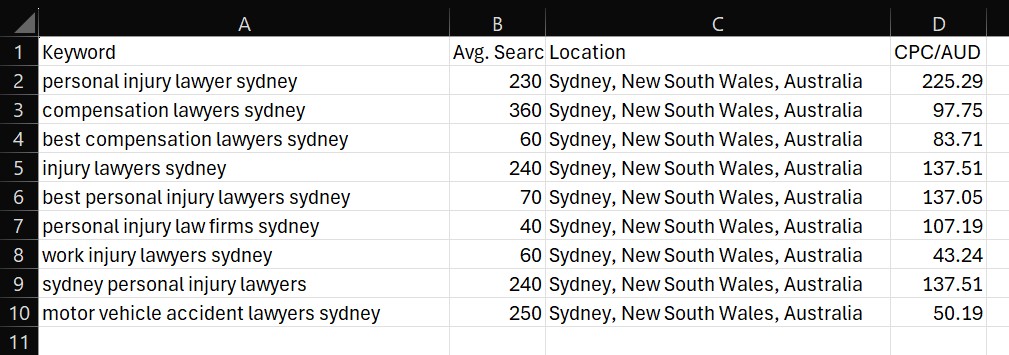
"Personal injury lawyer Sydney" now costs over $224 per click. Not per lead. Not per case. Per click. Most of those clicks don't even convert into enquiries, let alone paying clients.
"Injury lawyers Sydney" costs $137 per click. "Compensation lawyers" runs $97.54. "Injury claim lawyer" hits $203.
These aren't outliers. This is the reality of personal injury advertising in Australia right now.
Here's what that means in practice. If your conversion rate from click to enquiry is 5% (which is actually decent), you're paying $4,480 just to get one person to fill out a form. If your enquiry-to-client conversion rate is 25% (again, pretty solid), you're now at $17,920 per signed client.
And remember, you're running no-win-no-fee. You're waiting 12 to 24 months for settlements. The marketing costs hit your account today, but the revenue might not materialise for two years.
Shine and Slater & Gordon can make this work because they're operating at massive volume with institutional funding. They can afford to pay $800-1500 per lead because they've got the infrastructure, the funding, and the case values to support it.
You can't. Not at boutique firm scale.
The Trend Isn't Slowing Down
This isn't a temporary spike. Google Ads costs for personal injury keywords have increased consistently by 20-40% annually for five straight years.
Why? Competition keeps intensifying. More firms are fighting for the same limited ad space. Google knows PI firms are desperate for leads, so they keep pushing prices higher. And national firms with deep pockets keep bidding aggressively because they can afford to.
The trend line is clear. Next year will be more expensive than this year. The year after that will be worse again.
If you're hoping costs will stabilise or drop, you're waiting for something that's never going to happen.
Google Ads Broad Match: Why It's Probably Not Working for You
Here's the thing about broad match that Google won't tell you straight: it CAN work, but only if you've got the conversion volume to train it properly.
Google's pitch is that broad match combined with their AI will find you better leads than you could target manually. And technically, that's true. If you're feeding the algorithm 100+ conversions per month, it learns patterns and gets smarter about who to show your ads to.
But here's the problem: most PI firms in Australia aren't getting anywhere near that conversion volume.
You're maybe signing 10-15 new clients a month. Google's algorithm needs way more data than that to optimize effectively. Without sufficient conversion data, broad match just shows your ads to anyone vaguely related to your keywords.
You bid on "personal injury lawyer Sydney" and Google shows your ad for "personal injury lawyer jobs Sydney" or "free personal injury legal advice" or "how much do personal injury lawyers charge."
Zero intent to hire. Maximum cost to you.
When Broad Match Actually Works
Broad match works for firms that have:
-
High conversion volume (50+ conversions per month minimum)
-
Proper conversion tracking set up (more on this below)
-
Budget to burn through the learning phase
-
Patience to let the algorithm optimize over weeks, not days
If that's not you, stick with phrase match or exact match. You'll get fewer impressions, but the clicks you do get will be from people actually looking to hire a lawyer.
The Auto-Apply Trap
Even worse, Google's auto-apply recommendations actively push you toward broad match settings. They make it sound like you're "missing opportunities" if you don't enable it.
What they really mean is they want to show your ads to more people (regardless of intent) so they make more money from your clicks.
I've seen PI firm accounts where 40-50% of the budget was going to broad match searches that had absolutely no business clicking on a lawyer's ad. That's money straight down the drain.
If you haven't manually reviewed and tightened your match types, you're probably losing thousands every month to junk traffic.
Should Personal Injury Firms Still Use Google Ads?
This is the question I keep hearing from frustrated managing partners. And I get it. When you're spending $10,000, $20,000, even $50,000 a month and watching your cost per lead climb every quarter, it's natural to wonder if Google Ads even makes sense anymore.
Here's the honest answer: it depends on your expectations and your alternatives.
Google Ads still works if you understand what it actually is. It's not a lead generation channel. It's a lead capture channel. You're intercepting people who've already decided they need a lawyer. You're just trying to be the one they choose from the list.
That's valuable. But it's also incredibly expensive because you're competing with every other PI firm in your area for that same moment of decision.
The bigger question is this: do you have a better way to generate enquiries right now?
Most firms don't. They're relying on referrals (inconsistent), word of mouth (slow to scale), and Google Ads (expensive but at least it works). So they keep the ads running because turning them off means watching their pipeline collapse.
That's not a strategy. That's dependency.
The Pipeline Collapse Problem
Here's what happens when a PI firm turns off Google Ads without a replacement.
Week one: enquiries drop 40-60%. Week two: new signed cases drop to nearly zero. Week three: panic sets in. Week four: ads get turned back on at even higher budgets because you're now desperate.
This is why firms keep paying even when the economics make no sense. The alternative feels worse.
But here's what I want you to understand: the reason turning off Google Ads is so painful is because you haven't built any other predictable source of enquiries. You're dependent on a single channel that's squeezing you harder every month.
The solution isn't to keep feeding the beast. It's to build alternative sources before the costs get so high you're forced to make a desperate decision.
How to Reduce Your Cost Per Lead (Without Sacrificing Volume)
Let's talk about practical fixes you can implement right now to reduce wasted spend and improve your cost per lead.
These won't solve the fundamental problem (Google Ads will keep getting more expensive), but they'll buy you time and margin while you build out longer-term solutions.
Fix Your Match Types Immediately
Stop using broad match. I'm serious. Go into your account right now and switch everything to phrase match or exact match.
Yes, your impressions will drop. That's the point. You want fewer, better clicks from people who are actually looking to hire a lawyer, not students researching case law or people trying to DIY their claim.
Phrase match gives you enough flexibility to capture variations while cutting out the junk traffic that broad match attracts. Exact match is even tighter but can be too restrictive for some campaigns.
Start with phrase match. Monitor performance for two weeks. If you're seeing better conversion rates (even with fewer total leads), you're heading in the right direction.
Add Negative Keywords Aggressively
Most PI firm accounts have maybe 20-30 negative keywords. They should have 200-300.
Here's a starter list of terms you should be blocking immediately:
-
"Free" (free advice, free consultation seekers who won't hire)
-
"Jobs" (people looking for employment, not legal help)
-
"Salary" (same as jobs)
-
"Course" (students researching)
-
"Study" (same)
-
"How to become" (career research)
-
"DIY" (people trying to handle claims themselves)
-
"Template" (looking for forms, not lawyers)
-
"Sample" (same)
-
"Reddit" (people researching on forums, not ready to hire)
Every week, review your search terms report and add new negative keywords based on actual searches that triggered your ads. This is ongoing maintenance, not a one-time fix.
The goal is to block low-intent searches before they cost you money.
Improve Your Landing Page Conversion Rate
If your landing page converts at 3-5%, you're losing money. A properly optimised PI landing page should convert at 8-12% minimum, and I've seen firms hit 15-18% with the right setup.
Here's what's probably wrong with your current landing page:
-
Too many form fields (name, email, phone, case details, how did you hear about us). Cut it down to name, phone, brief description. That's it.
-
Generic copy that could apply to any law firm ("We fight for your rights"). Get specific about the outcomes you deliver.
-
No social proof above the fold. Testimonials, case results, reviews need to be visible immediately.
-
Weak or confusing call to action. "Contact us" is terrible. "Book your free case assessment" is better.
-
Mobile experience is broken. Over 60% of PI searches happen on mobile. If your page doesn't load fast and look good on a phone, you're losing half your traffic.
Even a small conversion rate improvement makes a massive difference. If you're spending $20,000 a month and getting 100 enquiries (5% conversion), improving to 10% conversion means 200 enquiries for the same spend. You just cut your cost per lead in half.
Block Competitor Brand Terms (Yes, Even on Phrase Match)
Here's something most PI firms don't realise: even if you're using phrase match or exact match, Google's "close variants" feature will still trigger your ads on competitor brand searches unless you actively block them.
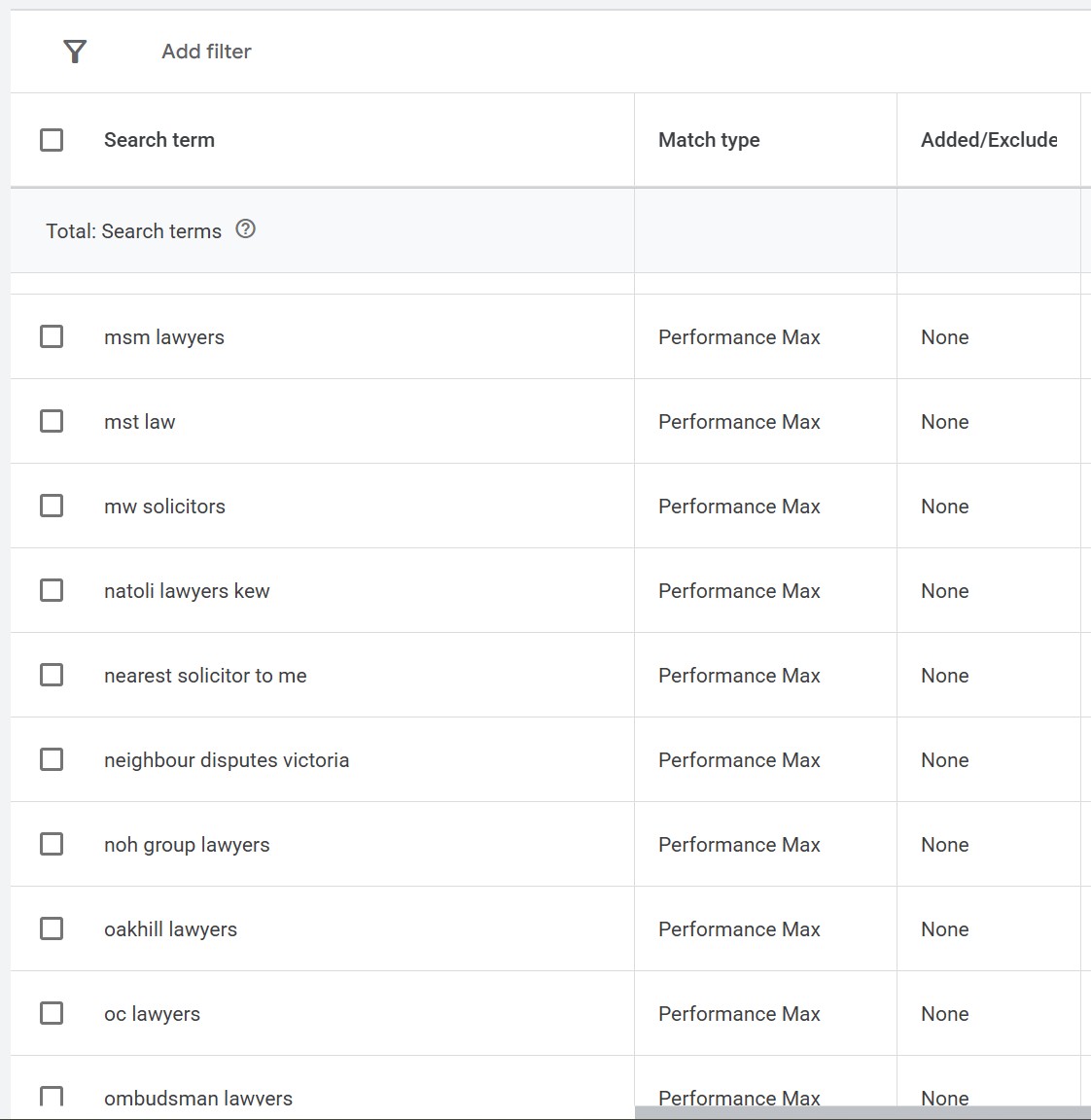
You might think you're not bidding on "Shine Lawyers," but Google sees someone search "Shine Lawyers Sydney" and decides your phrase match keyword "injury lawyers Sydney" is close enough. Next thing you know, you're paying for clicks from people specifically looking for your competitor.
This isn't a bug. It's intentional. Google calls it close variants, and it's designed to show your ads on searches they think are "related" to your keywords, even when they're clearly not.
The fix is simple but tedious: add every major competitor brand as a negative keyword. "Shine," "Slater and Gordon," "Maurice Blackburn," and every other national firm in your space. Do it now before you waste another few thousand on people who want someone else.
In rare cases, you might see competitor terms actually convert. Someone searches for a national firm, sees your ad, and decides to enquire anyway. But it's uncommon enough that for most boutique firms, the wasted spend isn't worth the occasional conversion.
Let the national firms fight over their own brand terms. You focus on the searches where you can actually win.
The Conversion Signal Problem (Or Why Google Keeps Finding You Bad Leads)
Here's something most PI firms completely miss: Google's AI isn't broken. It's doing exactly what you trained it to do. The problem is you're training it wrong.
Think about it like training a puppy. If you give the puppy a biscuit when it's done the wrong thing, you're rewarding bad behavior. The puppy learns to keep doing that wrong thing because it gets treats.
Google's algorithm works the same way. When someone fills out your form, Google counts that as a conversion. The algorithm learns "this is what success looks like" and goes looking for more people like that.
But what if half those leads are complete rubbish? What if they're asking about injuries from 10 years ago, or they weren't employed when the injury happened, or they don't have a case at all?
You're still counting them as conversions. You're telling Google "yes, more of these please." And Google delivers exactly that.
Performance Max and the AI Problem
This becomes even more critical with modern campaign types like Performance Max. Google's pushing everyone toward automation and AI-driven campaigns. The promise is that the algorithm will find leads for you automatically.
And it will. But whether it finds the RIGHT leads depends entirely on what you're telling it is "right."
Performance Max will absolutely drive form submissions. The question is whether those submissions are from people who could actually become paying clients, or just anyone vaguely interested in legal information.
If you're feeding Google conversion signals for every lead regardless of quality, you're teaching it to optimize for volume, not value.
How to Train Google Properly
Personal injury has an advantage here that most legal niches don't have: you can pre-qualify leads early in the process.
Instead of just asking for name, email, and phone number, add qualification questions that knock out obvious non-starters:
-
When did the injury occur? (If it's outside your limitation period, it's not a case)
-
Were you employed at the time of injury? (For workers comp cases)
-
Have you already accepted a settlement? (Dead lead if yes)
-
Is this your injury or someone else's? (Referral seekers)
These questions do two things. First, they filter out leads you can't help anyway, saving your team time. Second, and more importantly, they let you send better conversion signals to Google.
When someone completes your form AND meets your qualification criteria, that's a conversion you report to Google. When someone fills out the form but fails qualification, you don't report it as a conversion (or you report it as a lower-value conversion if you're using value-based bidding).
Now Google's learning from the right signals. It's getting rewarded for finding qualified leads, not just any leads. Over time, the algorithm gets smarter about who to target and who to skip.
Lead Scoring for Better Campaign Performance
If you want to get sophisticated about this, implement proper lead scoring that feeds back into Google Ads.
High-value lead (meets all criteria, strong case): Send conversion value of $1000 to Google Medium-value lead (meets criteria, uncertain case strength): Send conversion value of $500 Low-value lead (fails qualification): Send conversion value of $0 or don't report at all
Google's algorithm optimizes toward higher-value conversions. You're literally teaching it to find better leads by showing it which ones are worth more.
Most PI firms don't do this. They count every form fill as equal, wonder why their lead quality is terrible, and blame Google for sending junk traffic.
The algorithm is working fine. You're just training it with the wrong data.
The Real Problem: You're Competing When You Should Be Creating Familiarity
Here's the shift that's working for PI firms who've figured this out.
When someone searches "personal injury lawyer Sydney," they're in comparison mode. They see Shine. They see Slater & Gordon. They see your firm, maybe, if you're bidding high enough and your quality score is good enough.
You're one option among many. And the firms with the biggest budgets, the most reviews, the most brand recognition, they win that comparison more often than not.
But what if you could reach that same person three days before they search?
What if the conversation happened before they even knew they needed a lawyer? What if when they finally decided "I need help with this," your face was already familiar and your name was already trusted?
They wouldn't search "personal injury lawyer Sydney." They'd search your name. Or they'd just click through from your ad because they already feel like they know you.
That's not competition. That's operating in an ocean of one.
Reaching People Before the Search
This is where video-based advertising on platforms like Meta becomes powerful for PI firms.
You're not targeting people searching for lawyers. You're targeting people who fit the profile of someone who might need a PI lawyer soon. Someone who's been in a car accident. Someone dealing with a workplace injury. Someone whose circumstances suggest they might have a claim.
You show them a short video where you explain something valuable. Not a sales pitch. Genuine education about their rights, what they should watch out for, common mistakes people make.
They watch the video. They don't need a lawyer right now, so they scroll on. But you've planted something. When they do need help, they remember you. You're not some random firm competing with 10 others. You're the lawyer who helped them understand their situation before they even knew they needed help.
This approach requires consistency. You're not running ads for a week and expecting results. You're building familiarity over weeks and months. When someone in your audience does need a PI lawyer, you're the obvious choice because you're already familiar.
The Data Backs This Up
I've worked with PI firms implementing this strategy, and the economics are completely different.
Cost per enquiry through video-based Meta ads: $80-150. Cost per enquiry through Google Ads: $300-500 (and climbing). The quality of enquiries is better too because they're not comparing you to five other firms, they're coming to you specifically.
The conversion rate from enquiry to signed client is higher because trust is already established. They've seen your face. They've heard you explain things. They feel like they know you.
This isn't theoretical. This is happening right now for firms who've stopped trying to compete on Google's terms and started building familiarity before the search happens.
What About SEO for Personal Injury Law Firms?
Let me be direct about SEO because I see too many PI firms wasting money on services that will never deliver results.
If you're not already ranking in the top three for your key terms, catching up will cost you $5,000-10,000 per month for 12-18 months minimum. And that's just to start competing. Not to dominate. To compete.
Why so expensive? Because you're fighting firms that have been building domain authority for a decade. Shine Lawyers has thousands of pages indexed, hundreds of quality backlinks, and a domain age that gives them a massive head start.
You can't just "do SEO" for a few months and expect to outrank them. It doesn't work that way.
Is SEO Worth It for PI Firms?
For most boutique PI firms, no. Not as a primary lead generation strategy.
The time horizon is too long. The investment required is too high. The competitive landscape is too fierce. And even if you do everything right, you're still betting on Google's algorithm not changing in a way that wipes out your rankings.
That's a lot of risk and expense for uncertain returns that won't materialise for over a year.
If you've got capital to deploy and you're thinking 3-5 years out, sure, SEO can be part of your marketing mix. But if you need leads in the next 6-12 months to keep your firm growing, SEO is the wrong channel to focus on.
Local SEO Is Different
Now, Google Business Profile optimisation (local SEO) is a different story. That's fast, cost-effective, and actually works for PI firms.
Getting your GBP fully optimised, collecting reviews systematically, and showing up in the local map pack when someone searches "personal injury lawyer near me" delivers results much faster than trying to rank your website organically.
This should be part of every PI firm's marketing strategy. But it's not a replacement for paid advertising. It's a complement.
Building a Sustainable Lead Generation System
Here's what a sustainable PI lead generation system looks like in 2025.
You're not relying on a single channel. You're not dependent on Google Ads staying affordable (they won't). You're not waiting for SEO to kick in (it's too slow).
Instead, you've built a system that combines multiple channels, each with a specific role:
Video-based advertising (Meta, TikTok): Building familiarity and trust before someone needs a lawyer. This is your primary lead generation engine. You're reaching people early, educating them, making yourself the obvious choice when they do need help.
Google Business Profile: Capturing local searches from people ready to hire. This is defensive positioning. When someone does search, you want to show up in the map pack with strong reviews.
Retargeting: Staying in front of people who engaged with your video content or visited your website. Most people don't hire a PI lawyer the first time they see your ad. Retargeting keeps you top of mind until they're ready.
Referral systems: Making it dead simple for past clients to refer new clients. This is the highest quality lead source you have, and most firms completely neglect to systematise it.
Strategic Google Ads (small budget): Yes, you still run some Google Ads, but it's a small percentage of your total spend. You're not trying to win on volume. You're capturing specific high-intent searches where the economics still work.
This mix gives you consistency, predictability, and resilience. If one channel gets more expensive or less effective, you're not scrambling because you've got others delivering results.
What to Do Next
If you're a PI firm watching your Google Ads costs climb and your margins shrink, here's your action plan.
This week: Audit your Google Ads account. Check your match types. Review your negative keyword list (add all competitor brands immediately). Look at your search terms report and identify wasted spend. Fix the obvious problems.
Next week: Implement lead qualification. Add 3-4 qualification questions to your enquiry forms that identify whether someone has a viable case. Start tracking which leads meet your criteria versus which ones don't. This data becomes gold.
This month: Fix your conversion tracking. Stop sending every form fill to Google as a conversion. Set up lead scoring where qualified leads count more than unqualified ones. If you can't do this yourself, hire someone who can. This alone will transform your campaign performance over the next 60-90 days.
Next month: Test video-based advertising on Meta. Start small, $50-100 per day. Create 3-4 short videos explaining common PI scenarios in your area. Target your ideal client demographics. Track cost per view, cost per engagement, and cost per enquiry.
Next quarter: Build out your content library. More videos. Different angles. Different case types. Test what resonates. Scale what works. Create retargeting audiences from your best-performing content.
The goal isn't to replace Google Ads overnight. It's to reduce your dependency on them over time while building channels that give you more control and better economics.
Shine and Slater & Gordon will keep pushing Google Ads costs higher. That's inevitable. The only question is whether you'll still be trying to compete with them on their terms, or whether you'll be operating in a completely different way.
Final Thoughts
Personal injury Google Ads are expensive and getting worse. That's not changing.
But here's what you can control: the quality of leads your campaigns deliver and the signals you're sending to Google's algorithm.
Most PI firms are training Google to find more leads, when they should be training it to find better leads. Fix your conversion tracking. Implement qualification. Stop rewarding the algorithm for delivering rubbish.
And while you're doing that, start building alternative channels. The firms that thrive over the next few years won't be the ones who optimise their Google Ads campaigns 5% better. They'll be the ones who build lead generation systems that don't depend on winning auctions against national firms with unlimited budgets.
Start thinking about how to reach people before they search. Build familiarity through video. Show up consistently. Make yourself the obvious choice before the moment of decision even arrives.
That's how you compete when you can't afford to compete.
Need help building a lead generation system that doesn't depend on Google Ads staying affordable? Book a call and I'll show you exactly what's working for PI firms right now, no fluff, just the strategy and the economics behind it.